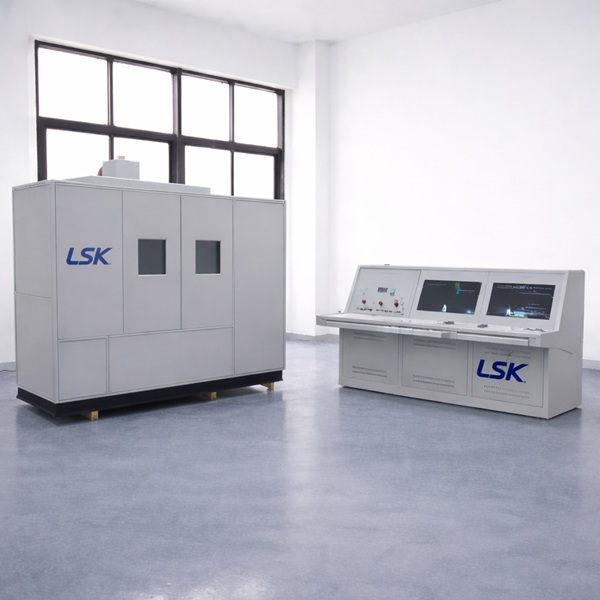
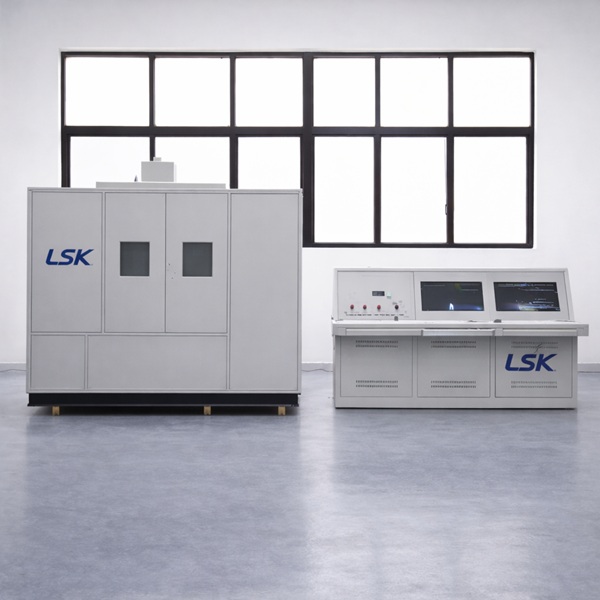
Model:LSK-TCZ
This test bench is used for compression (crush) and nail penetration performance testing of electric vehicle (EV) traction/power batteries. The test system is designed and operated in accordance with the following standards:
GB/T 31467.3-2015
Lithium-ion traction battery pack and system for electric vehicles — Part 3: Safety requirements and test methods
GB/T 31485-2015
Safety requirements and test methods for traction battery of electric vehicles
1. Main Application and Functions
1.1 Application
This test system is used for compression (crush) and nail penetration performance testing of electric vehicle (EV) traction/power batteries. The test bench is designed and operated in accordance with the following standards:
GB/T 31467.3-2015
Lithium-ion traction battery pack and system for electric vehicles — Part 3: Safety requirements and test methods
GB/T 31485-2015
Safety requirements and test methods for traction battery of electric vehicles
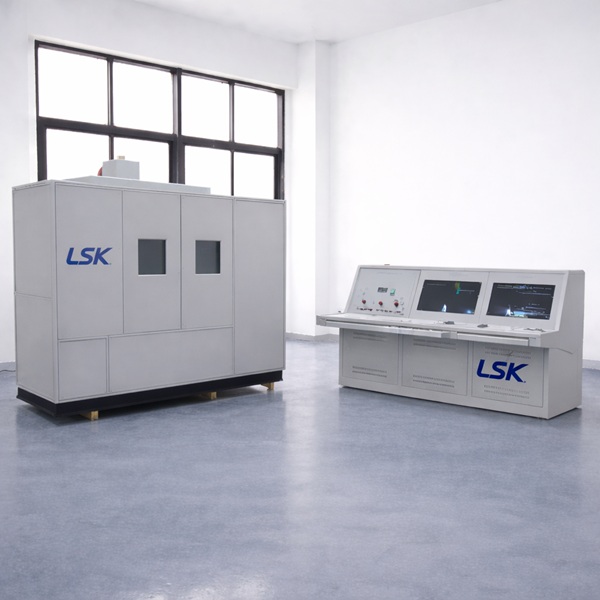
L 3000 mm × W 3000 mm
Horizontal type, with an open (un-enclosed) crush area.
Crush platen type: A semi-cylindrical platen with radius 75 mm. The length of the semi-cylinder shall be greater than the height of the battery under test, but not exceed 1 m.
Crush direction: X-axis and Y-axis directions (vehicle driving direction is X-axis; the other horizontal direction perpendicular to driving direction is Y-axis).
Crush endpoint: Stop crushing when the crush force reaches 200 kN or when the deformation reaches 30% of the overall dimension along the crush direction.
Hold time: Maintain the crush force at that condition for 10 min.
Observation: 1 h.
Crush direction: Apply force perpendicular to the direction of the cell plates (electrodes).
Crush platen type: A semi-cylindrical platen with radius 75 mm, with length L greater than the cell dimension.
Crush speed: (5 ± 1) mm/s.
Crush endpoint: Stop crushing when voltage reaches 0 V, or deformation reaches 30%, or crush force reaches 200 kN (whichever occurs first).
Observation: 1 h.
Use a high-temperature-resistant steel nail of Φ5 mm to Φ8 mm, penetrate at a speed of (25 ± 5) mm/s, perpendicular to the direction of the cell plates (electrodes), fully penetrating the cell.
The penetration location should be near the geometric center of the penetrated surface.
The nail shall remain in the cell.
Observation: 1 h.
Crush platen type: A semi-cylindrical platen with radius 75 mm. The length of the semi-cylinder shall be greater than the module dimension, but not exceed 1 m.
Crush direction: Same as the direction most likely to be subjected to crushing in the vehicle layout.
If such direction cannot be determined, apply force perpendicular to the arrangement direction of the single cells.
Crush speed: (5 ± 1) mm/s.
Crush endpoint: Stop crushing when the module deformation reaches 30%, or when the crush force reaches the greater of:
Number of cells in contact with the crush surface (n) — Crush force (kN)
n = 1: 200 kN
n = 2–5: 100 × n kN
n > 5: 500 kN
1000 times the module weight, and
the force value specified in the table below.
Hold time: 10 min.
Observation: 1 h.
Use a high-temperature-resistant steel nail of Φ6 mm to Φ10 mm, penetrate at a speed of (25 ± 5) mm/s, perpendicular to the direction of the cell plates (electrodes), and sequentially penetrate at least 3 single cells (the nail shall remain in the module/battery).
Observation: 1 h.