
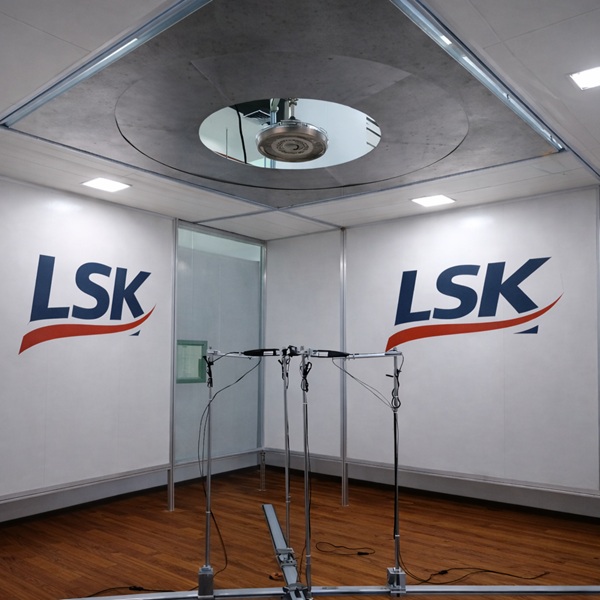
Recently, with the official commissioning of a pedestal-fan airflow laboratory in Jiangmen and the successful delivery of a ceiling-fan airflow laboratory in Suzhou, China’s fan airflow measurement equipment sector has entered a new wave of growth. Driven by tighter national standards, upgraded industrial demand, and supportive policies, the field is rapidly evolving from basic functional compliance toward greater intelligence, precision, and full-scenario adaptability—becoming a critical enabler for compliant overseas expansion and quality upgrades in the electric fan industry.
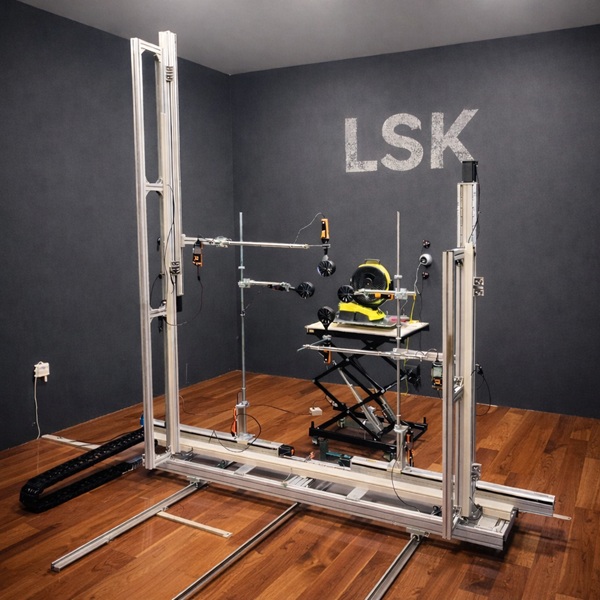
As the core tool for assessing fan performance, airflow measurement systems directly determine the accuracy and credibility of airflow data. They are essential for manufacturers to mitigate the risk of “inflated claims,” pass CCC certification, and meet market spot-check requirements. Such systems are widely used by fan manufacturers, third-party testing laboratories, and R&D teams. In recent years, continuous iteration of standards has clearly defined the direction for equipment upgrades. In 2025, China’s State Administration for Market Regulation (SAMR) issued GB/T 44298–2025 General Technical Requirements for Airflow Measurement Instruments, raising the measurement uncertainty requirement to ±1.2% of reading (full scale)—a 40% tightening compared with the 2020 edition—while also adding repeatability assessments under complex operating conditions. Internationally, the updated IEC 60879:2025 further tightens requirements for fan airflow testing procedures and energy-efficiency evaluation methods. Together, these dual standards are accelerating technological upgrades across the industry.
Technological innovation has become the key pathway to resolving industry pain points and keeping pace with the new standards. Today’s mainstream airflow measurement systems have matured into a collaborative architecture built around four core modules, delivering major breakthroughs in accuracy, efficiency, and adaptability:
Environmental control unit: Uses a modular, insulated, enclosed chamber design paired with high-precision temperature and humidity control—stabilizing ambient temperature at 20 ± 5°C and maintaining relative humidity at ≤65%—effectively shielding the test environment from external airflow and vibration interference.
Measurement execution unit: Typically equipped with imported high-precision anemometers (e.g., from Testo, Germany), achieving wind-speed accuracy of ±0.01 m/s + 1.5% of measured value. Combined with an intelligent automatic positioning system, it can automatically plan measurement points according to national standards to ensure full coverage of the effective air-delivery area.
Electrical parameter monitoring unit: Simulates household power fluctuations via a variable-frequency voltage-regulating power supply, synchronously collecting voltage, current, power, and other parameters to enable real-time linkage between airflow and electrical performance.
Intelligent control center: Integrates a touchscreen operating terminal and high-efficiency data processing. A single measurement point can be completed in as little as 3 minutes, and a CMA-marked test report can be generated within 2 hours. Data can be connected to MES and LIMS systems for end-to-end traceability.
At the same time, full-category compatibility and localized service capabilities continue to strengthen, further unlocking industrial value. Mainstream systems can now cover a wide range of products—including desk fans, pedestal fans, ceiling fans, bladeless fans, and industrial fans—without equipment replacement. The supported blade-diameter range has expanded to 200–1200 mm, meeting diverse needs across R&D, mass-production quality control, and certification testing. In terms of regional deployment, companies such as Langsike (朗斯科) are accelerating laboratory layouts in major home-appliance clusters like the Pearl River Delta and the Yangtze River Delta. Newly established labs in Jiangmen and Suzhou have significantly shortened local testing cycles and reduced total costs, providing localized technical support for “Made in Jiangmen” and “Made in Suzhou” fans to expand globally.
Policy support and market demand are jointly fueling steady market expansion. In 2025, the Ministry of Industry and Information Technology (MIIT) listed airflow instruments as a priority category in the Three-Year Breakthrough Action for the Industrialization of High-End Sensor Equipment (2024–2026), allocating RMB 3.8 billion in supply-chain technology upgrade subsidies for the year, benefiting 47 airflow instrument manufacturers. Meanwhile, the Ministry of Finance and the State Taxation Administration included airflow instrument manufacturers in the VAT additional deduction scheme for advanced manufacturing, further easing R&D and production pressures. On the demand side, with the rollout of the Action Plan for Continuous Air Quality Improvement and the normalization of fan energy-efficiency certification, China’s airflow instrument market is expected to reach RMB 45.9 billion in 2026, up 8.5% year-on-year. Shipments of smart, network-connected products are projected to exceed 51.2%, signaling a new phase driven by data and system-level collaboration.
Industry insiders note that the sector is entering a pivotal period characterized by “standard upgrades, technology iteration, and market expansion,” and will likely follow three major trends:
Accelerated localization and substitution: Continued improvements in domestic R&D for high-precision wind-speed chips and core sensors to reduce reliance on imports.
Deeper intelligence: Broader use of AI algorithms for data correction and performance prediction, enabling more precise optimization of both airflow and energy efficiency.
More scenario-based customization: Development of tailored solutions for niche applications such as EV cooling fans and large industrial fans, including extreme-environment simulation and dynamic airflow acquisition.
As technologies mature and the standards system becomes more robust, airflow measurement systems for electric fans will continue to empower high-quality industry development—helping manufacturers enhance competitiveness and steadily advancing the sector toward greater efficiency, energy savings, and compliance—while providing the global fan market with more reliable performance testing solutions.
Article Tags:
Copyright Notice:Unless otherwise specified, all articles on this site are Shenzhen Lansco Testing Instrument Co., Ltd.Original. Reprint with source and article link. https://www.lskplc.com/index.php/info/194.html。