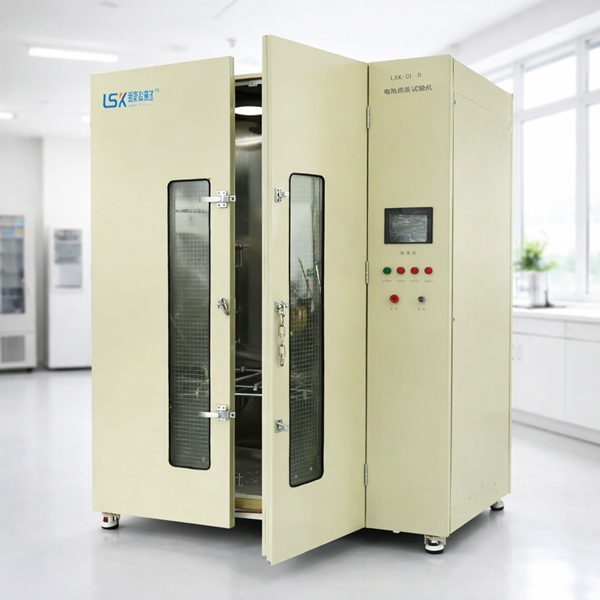
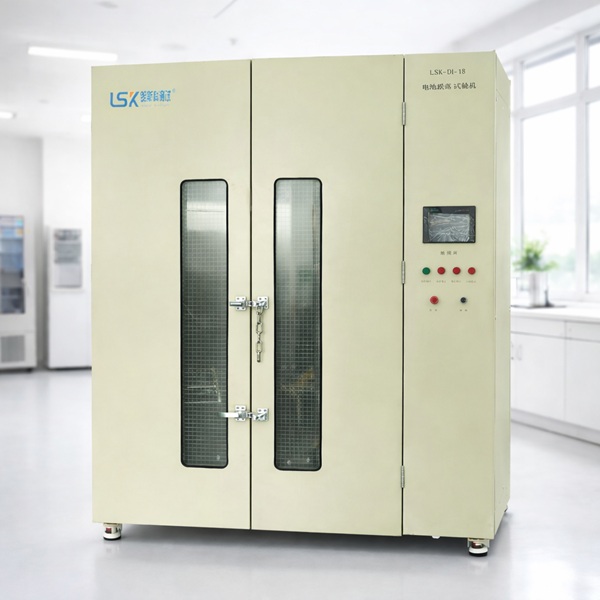
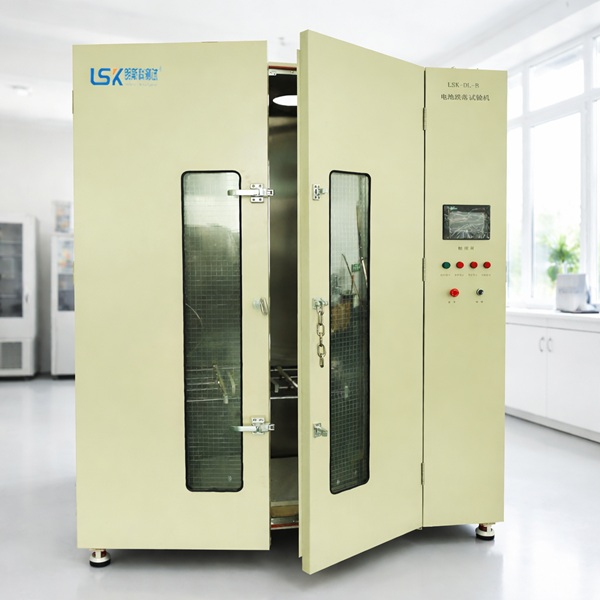
Model:LSK-DL2
Used for free-fall drop testing of primary lithium batteries and other primary batteries, as well as lithium-ion batteries (for digital electronic products such as mobile phones, laptop computers, and video cameras), NiMH, NiCd, and lead-acid batteries (for products such as power tools, toys, and electric bicycles). Complies with the requirements for free-fall drop test items specified in GB 8897.4-2002, GB/T 18287-2000, IEC 60086-4:2000, IEC 62133:2002, UL 1642:2006, SN/T 1413-2004, and SN/T 1414.3-2004.
Battery Drop Test Machine (this model is an enclosed type; an open type is also available)
Application: Used for free-fall drop testing of primary lithium batteries and other primary batteries, as well as lithium-ion batteries (for digital electronic products such as mobile phones, laptop computers, and video cameras), NiMH, NiCd, and lead-acid batteries (for products such as power tools, toys, and electric bicycles).
Complies with the requirements for free-fall drop test items specified in GB 8897.4-2002, GB/T 18287-2000, IEC 60086-4:2000, IEC 62133:2002, UL 1642:2006, SN/T 1413-2004, SN/T 1414.3-2004, and other relevant standards.
As the requirements for free-fall drop testing vary slightly among the above standards, the battery free-fall drop test apparatus shall meet all of the following requirements:
Drop the battery sample freely from a height of 1000 mm (height measured to the lowest point of the sample) onto a 18–20 mm thick hardwood board placed on a concrete floor. Perform one drop in each of the ±X, ±Y, ±Z directions (six directions total).
Drop the battery six times from a height of 1 m onto a hardwood board; the battery shall be dropped twice on each face.
Drop the battery from a height of 1 m onto a concrete surface; each test battery shall be dropped six times.
The apparatus adopts a fully enclosed cabinet structure. The drop test chamber is isolated from the mechanical parts of the equipment body and electrical wiring, etc. (except for the lifting shaft section of the hoisting mechanism).
The drop test chamber is equipped with explosion pressure relief and exhaust functions, capable of instantly releasing the pressure generated by a specimen explosion and discharging smoke and dust produced by the explosion.
The chamber provides moderate corrosion resistance and is easy to clean. It can withstand corrosive liquids generated by battery explosions and allows convenient washing/cleaning.
The apparatus supports two relatively independent control modes: remote control and local (on-site) control. The drop height can be preset and displayed, and the drop process is completed via automatic control.
The chamber is fitted with a bullet-resistant observation window for monitoring the drop test process.
The chamber provides pressure monitoring and audible & visual alarm functions to determine whether an explosion has occurred and to issue alarms.
Drop height range: 300 mm–1200 mm (customizable)
Height tolerance: 0 to +5 mm
Drop base area: 600 mm × 600 mm (customizable)
Max. specimen weight: 30 kg (customizable)
Max. specimen size: 500 mm
Drop accuracy: ±10 (unit not specified in the original text)
Drop plane deviation: ≤ 1°