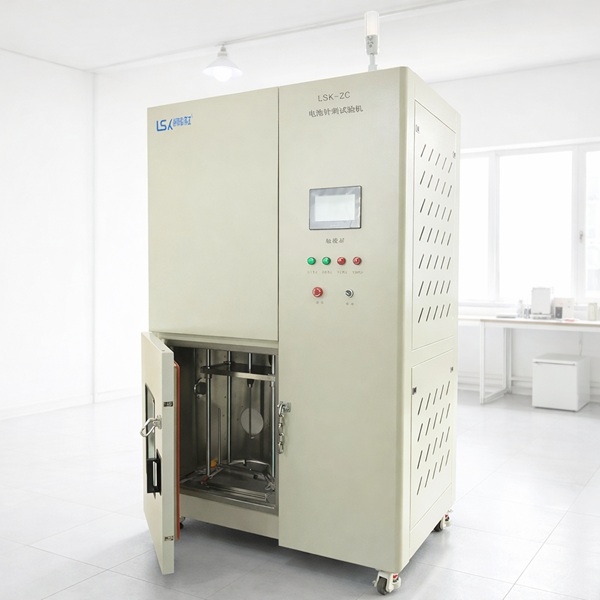
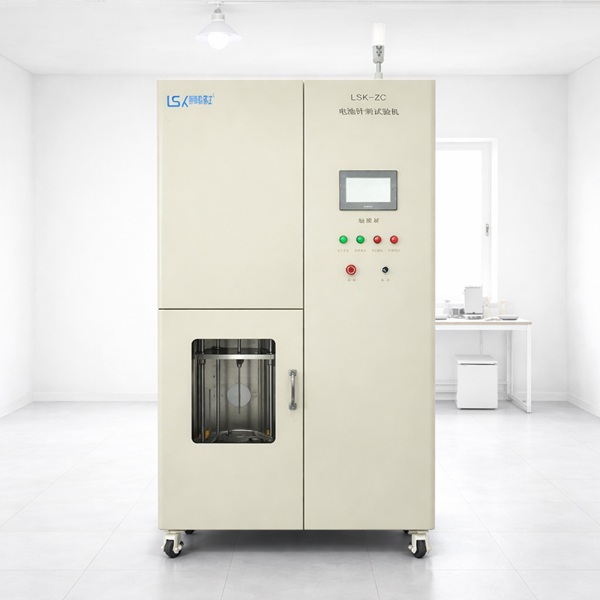
Model:LSK-ZC
Battery Nail Penetration Test Machine: Complies with the requirements for nail penetration testing specified in GB 8897.4-2002, IEC 60086-4:2000, UL 1642:2006, SN/T 1414.1-2004, SN/T 1414.3-2004, and other applicable standards. It is used for nail penetration tests on lithium primary batteries and other primary batteries, as well as lithium-ion batteries (for mobile phones, laptops, camcorders and other digital electronic products), NiMH, NiCd, and lead-acid batteries (for power tools, toys, electric bicycles, etc.).
Used for nail penetration tests on lithium primary batteries and other primary batteries, as well as lithium-ion batteries (for mobile phones, laptops, camcorders and other digital electronic products), NiMH, NiCd, and lead-acid batteries (for power tools, toys, electric bicycles, etc.).
The Battery Nail Penetration Test Machine complies with the nail penetration test requirements specified in GB 8897.4-2002, IEC 60086-4:2000, UL 1642:2006, SN/T 1414.1-2004, SN/T 1414.3-2004, and other relevant standards.
The nail penetration test requirements in the above standards differ slightly. Therefore, the nail penetration test system shall be capable of meeting all of the following requirements:
Power/Actuation mode: Pneumatic actuation.
The machine supports two control modes: pressure control and time control.
Control system options: (1) Microcontroller (MCU) control; (2) PLC control; (3) PC-based control.
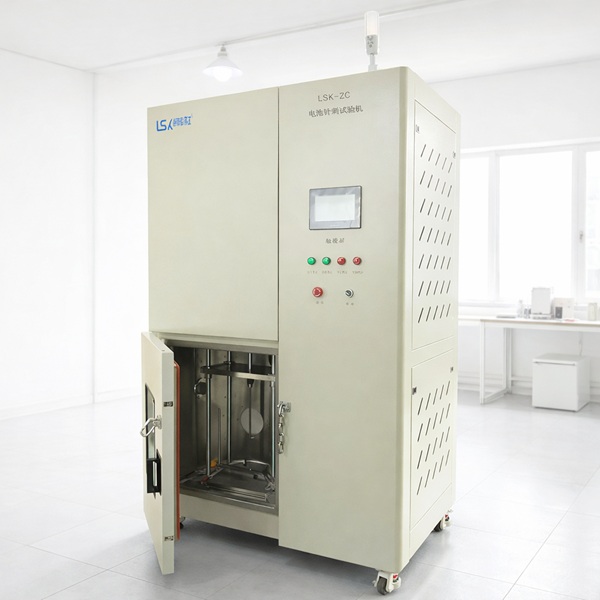
Meets the test requirements of QC/T 743-2006 “Lithium-ion Battery for Electric Vehicles”, QC/T 743-201X (revised edition to be issued), GB 8897.4-2008 “Primary Batteries—Part 4: Safety of Lithium Batteries”, QB/T 2502-2000 “General Specification for Lithium-ion Batteries”, etc.
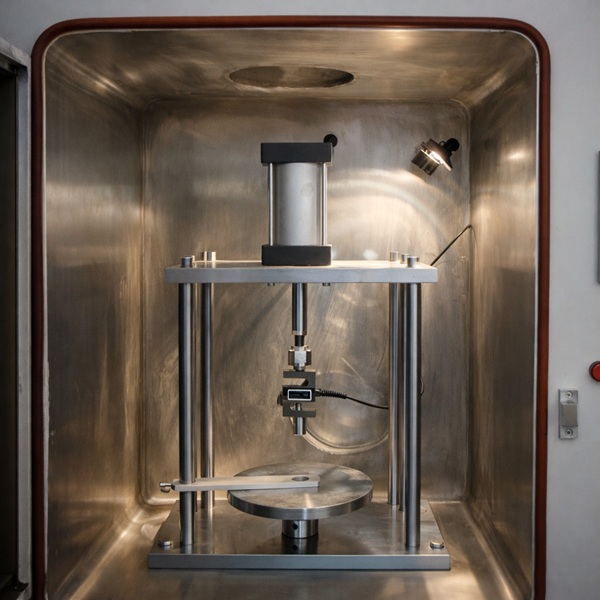
Chamber internal dimensions: not less than 600 × 600 × 600 mm; maximum battery size: 500 × 500 × 500 mm.
For nail penetration tests on cell and module batteries, the nail head size/shape, steel nail diameter, length, etc. shall comply with the requirements of the standards listed in 4.1, and shall be easy to install, remove, and replace.
Penetration speed: adjustable 10–50 mm/s; drive mode: electro-hydraulic servo drive.
Penetration force: adjustable 10–50 kN.
Stroke (hydraulic cylinder stroke): 0–500 mm; test platform supports lift adjustment to obtain different specimen placement heights.
High-temperature-resistant tungsten steel nail, diameter Φ2.5–Φ10 mm.
Supplied with a 300 mm-thick intermediate load-bearing plate to facilitate nail penetration testing of smaller batteries.
The test chamber is equipped with an intelligent video monitoring camera system and an electronic door interlock; the test can only start when the door is properly closed. Includes an explosion-proof observation window and explosion-proof lighting.
The enclosure is made of high-strength steel, with double-layer structure; inner layer thickness ≥10 mm, with thermal insulation cotton and cushioning film in between; steel door thickness ≥10 mm. The inner chamber liner is made of corrosion-resistant insulating material. All internal corners adopt rounded (radius) design with no spliced seams at corners. The chamber includes a drain hole and filter screen for easy cleaning.
Equipped with a smoke detection alarm and an independent exhaust duct venting to outdoor; the duct is made of non-combustible material for discharging toxic gases. Includes a high-power exhaust system capable of rapidly removing toxic gases from the chamber, a smoke filtration system, and an indoor air purification system to eliminate smoke/toxic gas leakage into the laboratory.
Monitors the internal chamber temperature for fire prevention purposes. If a fire occurs during testing, the automatic fire suppression system can be activated quickly.
The chamber is equipped with a pressure relief valve; in the event of an explosion, pressure will be released rapidly to the outside to protect the chamber and surrounding personnel.
Supports both local (on-site) and remote control.
Penetration control supports force control and displacement control; force/displacement can be held in multiple stages, enabling multi-step programmable control.
Penetration stop conditions can be set by force limit, penetration depth limit, and voltage limit, to stop the penetration test.
PC remote control and PLC control support simultaneous acquisition of voltage, temperature, force/pressure, and speed. Voltage & temperature acquisition: ≥8 channels. Test time and stroke can be set freely. Penetration depth, voltage, and temperature values/curves can be monitored in real time. Data are displayed on an LCD for convenient recording and can be exported and saved in Excel format.
Control/measurement accuracy: Force control ±1%; Displacement control ±1%; Speed control ±0.1 mm/s; Voltage measurement ±0.5% of reading; Temperature measurement ±1°C, display resolution 0.1°C.
Data acquisition rate: ≥100 samples/s; Voltage display: 0–200 V; Temperature display: 0–1200°C.
Penetration hold time adjustable.
Hardware includes an emergency stop function. Input protections: undervoltage, overvoltage, overcurrent, phase loss, overload, overtemperature shutdown alarm. Output protections: overvoltage, overcurrent, overload.