

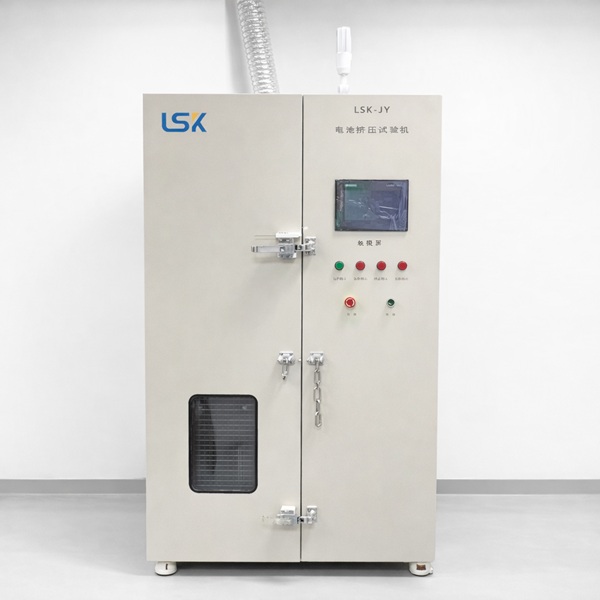
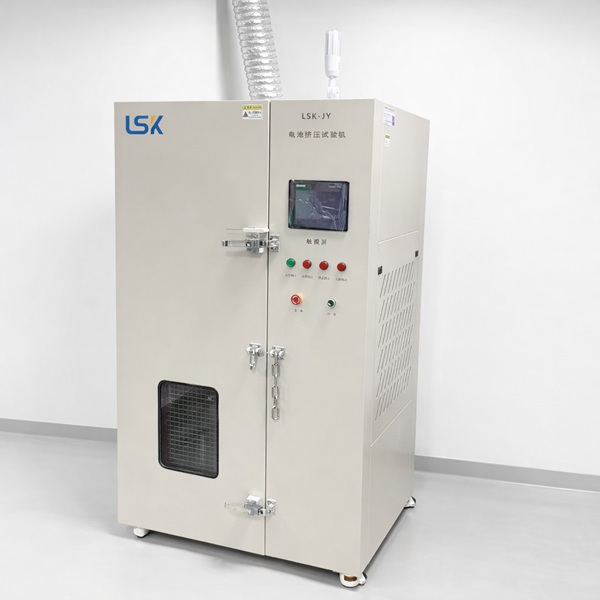
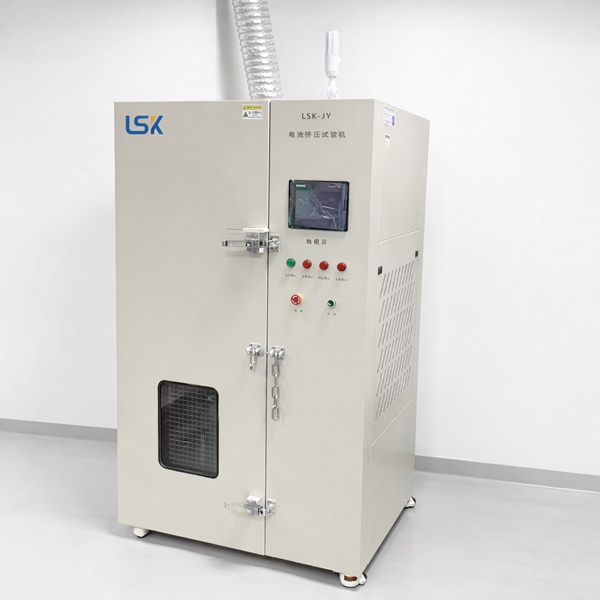
Technical Specification Requirements:
1. Scope of Application
1.1 Applicable Standards
The battery crush (compression) test apparatus complies with the crush test requirements specified in GB8897.4-2002, GB/T18287-2000, IEC 60086-4:2000, IEC 62133:2002, UL 1642:2006, SN/T1413-2004, SN/T1414.3-2004, GB 31241-2014, and other relevant standards.
1.2 Test Requirements
As the requirements for battery crush testing vary slightly among the above standards, the battery crush test apparatus shall be capable of meeting all of the following test requirements:
The battery is crushed between two flat plates. The crushing force is applied by a hydraulic piston with a diameter of 32 mm. Compression continues until the pressure reaches 17.2 MPa, corresponding to an applied force of 13 kN. After the maximum pressure is reached, the pressure is released.
The crushing device shall be able to provide a crushing force of 1140 ± 20 N on all test surfaces of the battery. Place the battery between two flat hardwood plates (minimum thickness 12.7 mm) and gradually increase the force to 1140 ± 20 N; maintain this force for at least 1 minute.
The test battery is crushed between two flat plates using a vise or a hydraulic arm with a piston diameter of 32 mm, applying a crushing force of 13 kN. Crushing continues until the pressure gauge on the hydraulic device reads 17 MPa. Once the maximum pressure is reached, the crushing load is released.
2. Main Technical Parameters and Functions
2.1 Main Technical Parameters
Maximum crushing force: > 15 kN
Max. relative crushing stroke (adjustable): > 500 mm
Base area of working chamber: 600 mm × 600 mm
Max. specimen size: 500 mm
Test space: not less than 850 × 300 × 300 mm (L × W × H)
Viewing window size: 500 × 500 mm (double-layer 10 mm explosion-proof glass with safety film)
Exhaust fan outlet: Ø150 mm (exhaust fan installed at the rear of the chamber)
Air inlet ports: two Ø50 mm ports on the left side of the chamber (can also be used for voltage measurement, etc.)