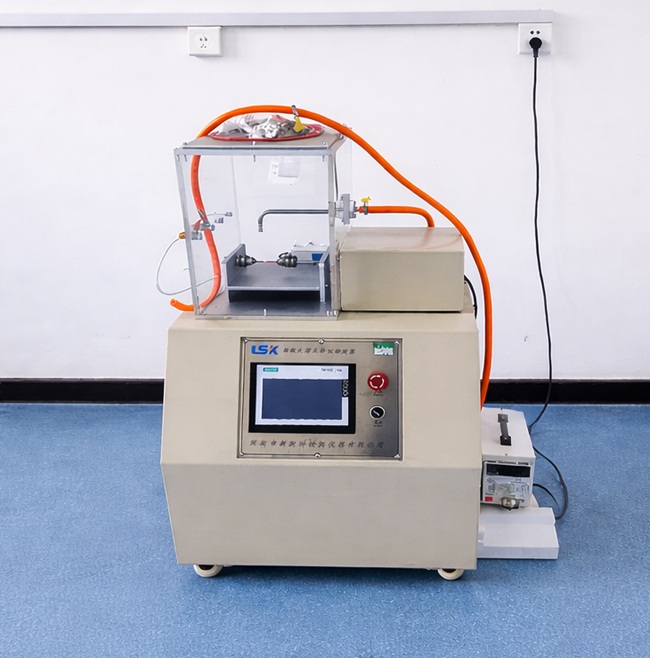
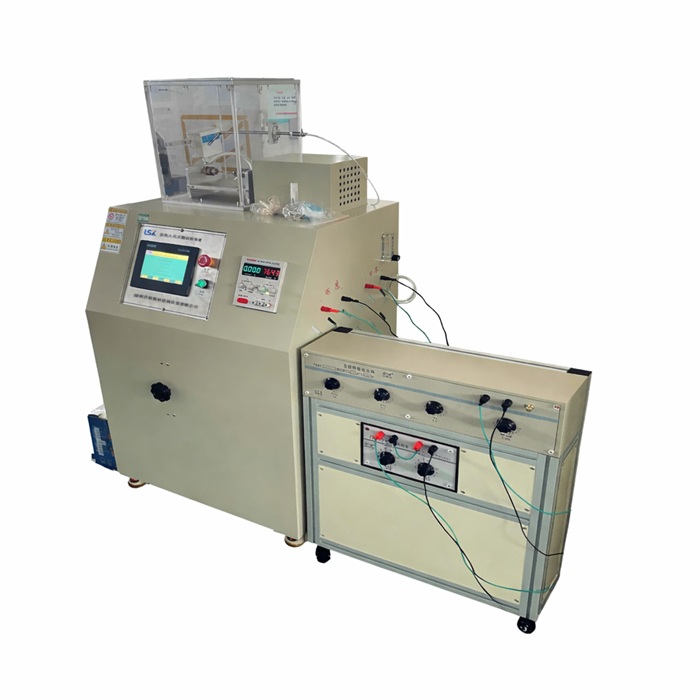
Model:LSK-FY7
The oxygen-enriched atmosphere spark ignition test machine fully complies with the requirements of IEC 60601-1:2012, Sub-clause 11.2.21, as well as the test requirements specified in Clause 11.2 of GB 9706.1-2020.
1. Equipment Overview
The oxygen-enriched spark ignition test apparatus fully complies with the requirements of IEC 60601-1:2012, Sub-clause 11.2.21, and the test requirements specified in Clause 11.2 of GB 9706.1-2020.
It is intended for use by manufacturers of ME equipment or ME systems, as well as medical device regulatory testing and inspection organizations. An oxygen-enriched atmosphere is defined as an environment in which the oxygen concentration is greater than 25% when the ambient pressure does not exceed 110 kPa; or, when the ambient pressure exceeds 110 kPa, the oxygen partial pressure is greater than 27.5 kPa. This test apparatus is used to conduct spark ignition tests on medical device PCBs/boards or components in an oxygen-enriched atmosphere to determine whether an ignition source is present.
The system adopts a Siemens (Germany) PLC with a touchscreen HMI, enabling automated testing and automatic acquisition of voltage and current data during the test, with results displayed on the instrument interface.
2. Structure and Operating Principle
The oxygen-enriched atmosphere spark ignition test apparatus is designed in accordance with the schematic principles specified in the relevant standards. Two electrodes made of appropriately selected materials are positioned facing each other (see figure below). One electrode has a diameter of 1 mm, and the other has a diameter of 3 mm. The power supply is connected to the + / − terminals as shown.
A piece of cotton is placed near the contact area of the two electrodes. Oxygen is continuously delivered through a duct onto the contact area at a velocity of not less than 0.5 m/s. The cathode is moved toward the anode to approach the contact surface and then pulled back to separate it, generating sparks.
The operation is repeated at least 300 times to determine whether the sparks cause ignition. If the spark becomes weak due to deterioration of the electrode surfaces, clean the electrodes with a file. If the cotton turns black due to oxidation, replace it with new cotton.
3. Main Technical Specifications
Test speed: 0–60 cycles/min (presettable).
Test cycles: 1–9999 cycles (presettable); displays the current cycle count. The machine stops automatically upon completion and provides an alarm indication.
Striker travel (adjustable range): 0–80 mm (presettable); real-time position display.
Monitored parameters: oxygen concentration; oxygen flow rate (adjustable 0–3 L/min).
Open-circuit voltage: 0–100 VDC; voltage display accuracy: 0.1 V ±5%.
Short-circuit current: 0–100 ADC; current display accuracy: 0.1 A ±5%.
Alarm & status indication: green light = automatic running; red light = stopped; buzzer provides fault/alarm alert.
Online monitoring: during testing, the test process can be monitored in real time and recorded via a video monitoring system; data can be uploaded to a host control system via wired or wireless connection.
Independent ventilation and lighting system for better observation of arcing at the instant of striker impact.
External power/load unit:
Programmable DC power supply: output voltage 0–300 V adjustable; output current 0–20 A adjustable.
Adjustable resistive load: 0–200 Ω, power rating 3 kW.